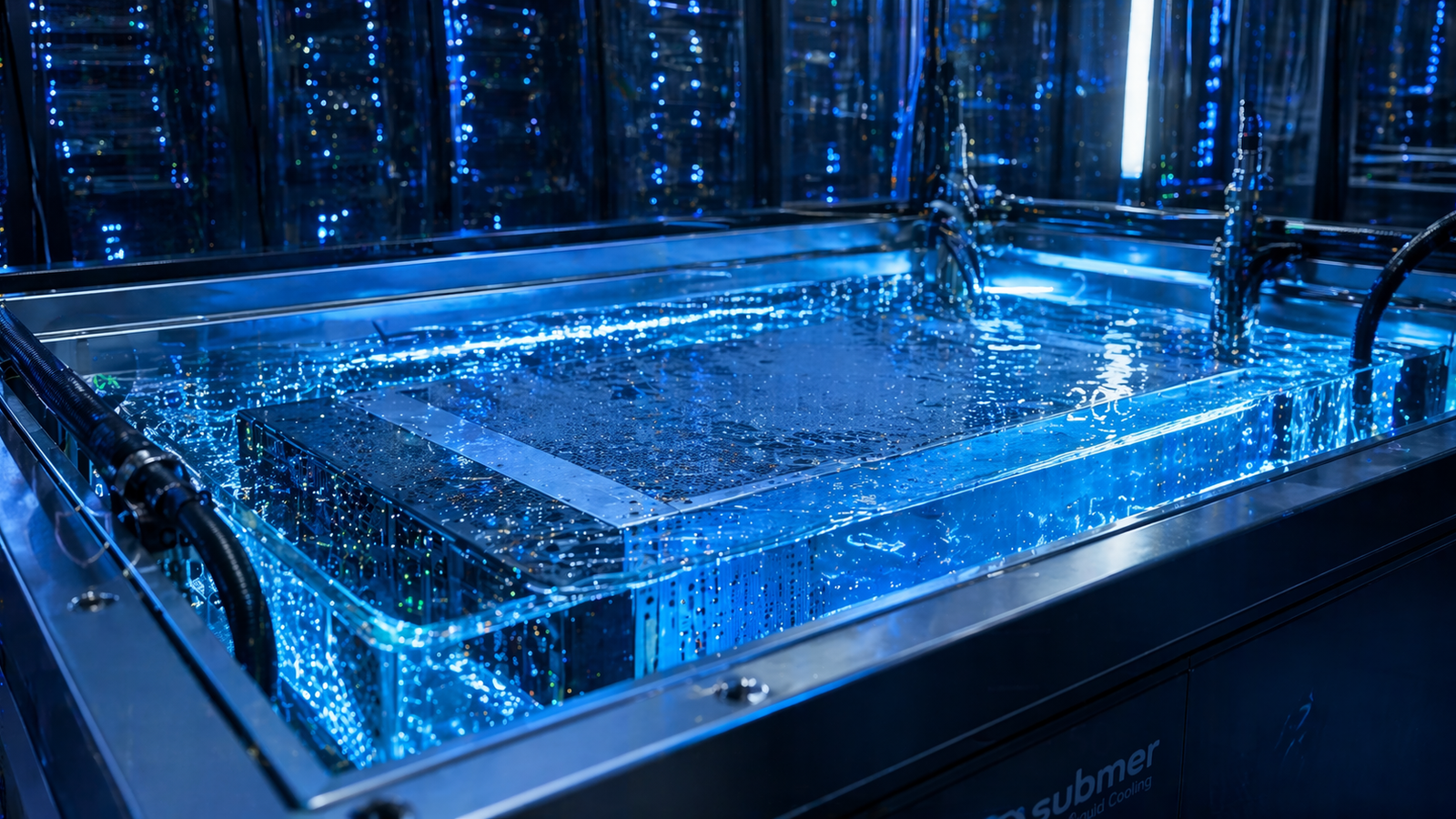
There is a quiet revolution happening inside the world's most powerful data centers, and it looks nothing like the sleek, whirring server rooms of popular imagination. Instead of rows of humming machines cooled by blasts of refrigerated air, the next generation of AI infrastructure may resemble something closer to an industrial fish tank — servers, GPUs, and all their electronic complexity submerged in shimmering, crystal-clear fluid that is about to change the economics and physics of computing forever.
The technology is called dielectric fluid immersion cooling, and while its roots stretch back decades into the world of high-performance and experimental computing, it is now erupting into the mainstream with the force of a $15 billion industry. The driving pressure behind this surge is simple: artificial intelligence is generating an extraordinary amount of heat, and our traditional methods of managing that heat are buckling under the strain.
The Thermal Crisis at the Heart of the AI Boom
To understand why dielectric fluid has become one of the most discussed topics in technology infrastructure, one must first grasp the scale of the heat problem facing the industry. Every computation generates heat. Every transistor that switches, every memory cell that activates, every data packet that moves through a network node releases thermal energy into the surrounding environment. For decades, data centers managed this problem with a combination of cold air, raised floors, hot-aisle and cold-aisle containment, and massive cooling infrastructure — a system that worked adequately for general-purpose computing.
But AI changed the rules of the game in a fundamental way. Training and running large language models, generative image systems, recommendation algorithms, and autonomous agents requires GPU clusters operating at intensities that dwarf conventional workloads. Where a traditional server rack might consume five to fifteen kilowatts of power, a modern AI-focused rack loaded with NVIDIA's latest accelerators can demand upward of 132 kilowatts. Next-generation systems are already being designed for 240 kilowatts and beyond. The heat those systems produce is staggering — and air simply cannot remove it fast enough.
The numbers tell a sobering story. The U.S. Department of Energy estimates that data centers consumed more than 4.5 percent of all electricity in the United States in 2025, a figure expected to climb to somewhere between 6.7 and 12 percent by 2028. Cooling systems alone account for between 25 and 40 percent of total data center electricity consumption. Globally, the International Energy Agency projects that data center electricity consumption will reach 260 terawatt-hours per year by 2026. These figures represent not just an engineering problem, but an environmental one — and a financial one. For the hyper scalers and cloud giants pouring hundreds of billions of dollars into AI infrastructure, cooling is quickly becoming one of the most critical cost variables in the entire equation.
"As AI has made racks denser and hotter, liquid cooling has become the de facto solution for the industry."
— Karin Overstreet, President, Nortek Data Center Cooling
The Technology: What Is Dielectric Fluid — And Why Does It Work?
Dielectric fluid is, at its most fundamental level, a liquid that does not conduct electricity. This property — electrical insulation — is what makes it safe to use in direct contact with the delicate circuit boards, processors, and memory modules that make up modern computing hardware. Unlike water, which would cause catastrophic short circuits and component damage if it touched a live circuit board, dielectric fluids can be poured directly over operating electronics without any risk of electrical conduction.
This non-conductivity is only one half of the fluid's appeal. The other is its thermal capacity — its ability to absorb and carry away heat far more efficiently than air. To illustrate the difference in a visceral way, consider what happens when you plunge your hand into boiling water versus holding it over a pot of steam. Steam, like air, transfers heat relatively slowly. Boiling water, like liquid coolant, transfers heat almost instantaneously. As Seamus Egan, general manager of immersion cooling at Airedale by Modine, puts it: stick a hand into boiling water and third-degree burns occur instantly, because liquid transfers heat far, far more quickly than air or vapor. That same physics principle, channeled constructively, is the foundation of immersion cooling.
Dielectric fluids used in data centers come in several formulations, each with distinct properties tailored to different cooling approaches. Mineral oils and hydrocarbon-based fluids represent the most widely deployed category, particularly for single-phase immersion systems. Synthetic dielectric fluids — engineered compounds designed for specific thermal, chemical, and environmental properties — are projected to capture the majority of the coolant market through the latter half of this decade. Fluorocarbon and perfluorinated fluids are favored in two-phase systems because of their low boiling points. And an emerging category of biobased and specialty engineered coolants is beginning to address the environmental concerns associated with older fluorocarbon chemistries.
Types of Dielectric Fluid Cooling — At a Glance
- Single-Phase Immersion: Server fully submerged in mineral or synthetic oil; fluid circulates through a heat exchanger and returns as liquid
- Two-Phase Immersion: Low-boiling-point fluid vaporizes on contact with hot components; vapor condenses on a heat exchanger and returns — highly efficient, no pump needed
- Direct-to-Chip (D2C): Dielectric fluid flows through sealed cold plates affixed directly to CPUs and GPUs; used in hybrid cooling architectures
- Two-Phase D2C: Fluid boils inside cold plates, handling heat densities up to 1,000 W/cm²; the frontier of thermal management technology
- Hybrid Systems: Combines air cooling for ambient temperature management with immersion or D2C liquid cooling for the hottest components
- Embedded Silicon Cooling: Microscale channels etched directly into semiconductor wafers; pioneered by TSMC for next-generation chip architectures
How It Works: From Open Bath to Boiling Oil: The Architecture of Immersion Cooling
In a single-phase immersion cooling system, the data center's familiar architecture of vertical server racks gives way to a different physical paradigm entirely. Servers are pulled from their traditional casings, stripped of their fans — which are unnecessary when liquid is doing the thermal work — and submerged horizontally or vertically in large tanks filled with dielectric oil. These tanks, roughly the size of refrigerators, replace the traditional rack footprint. Pumps circulate the fluid continuously through the tank and out to an external heat exchanger, where the accumulated thermal energy is transferred to a facility water loop or cooling tower. The cooled fluid then returns to the tank, creating a closed-loop system that operates with remarkable efficiency.
Two-phase immersion cooling goes further still, exploiting the thermodynamics of phase change to achieve even greater heat removal rates. In these systems, the dielectric fluid is chosen specifically because it boils at a relatively low temperature — typically somewhere between 34°C and 60°C depending on the fluid formulation. When a hot chip makes contact with this liquid, it causes the fluid to boil at the point of contact, and that boiling — the transition from liquid to vapor — absorbs enormous amounts of energy in the form of latent heat. The resulting vapor rises through the tank, condenses on a cooler heat exchanger surface mounted at the top of the tank, and drips back down as liquid to repeat the cycle. This passive, self-sustaining loop requires little to no pumping power, making it extraordinarily energy-efficient.
Both approaches share several operational advantages that extend beyond raw thermal performance. Because there are no fans, the noise profile of an immersion-cooled facility is dramatically lower than a conventional air-cooled data center. The absence of fans also eliminates a major source of mechanical failure and maintenance burden. And because the fluid completely envelopes every component, there are no hot spots — the localized temperature spikes that in air-cooled systems can degrade processor performance, shorten hardware lifespan, and cause unpredictable failures in AI training runs.
✦ ✦ ✦
Adoption: Big Tech Bets on the Liquid Future
The transition from experimental technology to mainstream infrastructure is being driven by the largest names in the technology industry. Microsoft has been among the most public advocates and early adopters, conducting trials with two-phase immersion cooling for AI training clusters and reporting significant energy savings as a result. In May 2025, the company expanded its immersion cooling pilot programs across European data centers in partnership with Submer Technologies, focusing specifically on sustainable dielectric fluid formulations and efficiency optimization for AI workloads. Microsoft's advanced AI supercomputer unveiled in 2025 features exclusively liquid-cooled racks built to support the training demands of next-generation large language models.
Meta has been exploring immersion cooling for the dense GPU workloads powering its generative AI models, while Google's TPU deployments and Meta's LLaMA model training infrastructure have both made the shift to liquid cooling architectures. Intel formalized its immersion cooling strategy in May 2025 through a partnership with Shell Global Solutions to launch the first Intel-certified immersion cooling solution for fourth and fifth generation Xeon processors — a development that signals the technology has reached the certification and enterprise-support maturity that large-scale production deployments require.
Chinese cloud providers have also been notable early movers, deploying immersion cooling at significant scale across high-density campuses where the combination of space efficiency and cooling cost reduction has made the economics compelling. Companies like Submer Technologies, LiquidStack, Green Revolution Cooling, and Iceotope Technologies have emerged as the specialist infrastructure providers enabling these deployments, offering integrated systems that span immersion tanks, coolant distribution units, heat rejection systems, and intelligent monitoring platforms.
Company / PartnershipApproachStatus
Microsoft + Submer
Two-phase immersion for AI training clusters; European pilot expansion
Active / Scaling
Intel + Shell
First Intel-certified single-phase immersion for Xeon 4th/5th Gen
Production-ready (May 2025)
Iceotope + Engineered Fluids + Juniper
Sealed-chassis immersion + single-phase dielectric + AI-native networking
Strategic partnership live
NorthC Datacenters
Immersion cooling with waste heat reuse for district heating (Rotterdam)
In deployment
Meta
Immersion for dense GPU workloads; generative AI model training
Exploratory / Expanding
TSMC
Direct-to-silicon embedded liquid cooling using SoIC bonding technology
Research / Early commercialization
Performance: The Numbers Behind the Hype
The performance case for dielectric immersion cooling is not merely theoretical — it is measurable, and the numbers are striking. According to research by Vertiv, the introduction of liquid cooling in high-density data centers created a 10.2 percent reduction in total data center power consumption and a more than 15 percent improvement in Total Usage Effectiveness, a key industry metric that captures how efficiently a facility converts incoming power into useful computation.
Immersion cooling allows rack densities that are simply impossible with air. While an air-cooled facility might safely support racks consuming 10 to 20 kilowatts, dielectric immersion systems routinely achieve over 100 kilowatts per rack equivalent, with some specialized designs reaching 250 kilowatts or beyond. Green Revolution Cooling's ICEraQ system achieves up to 368 kilowatts of cooling capacity while maintaining a power usage effectiveness ratio below 1.03 — a figure that represents near-perfect energy efficiency for a cooled computing environment. The approach also allows operators to pack 10 to 15 times more compute into the same physical footprint, dramatically altering the economics of building and operating AI infrastructure at scale.
Water consumption — a growing concern as data centers expand into drought-prone regions — is another area where dielectric immersion cooling outperforms conventional alternatives. Evaporative cooling methods, standard in many hyperscale facilities, consume enormous volumes of water. Single-phase immersion cooling, by contrast, has been shown to reduce water consumption by up to 99 percent in optimized deployments. For communities and regulators increasingly scrutinizing the water footprint of technology infrastructure, this is a significant advantage that is beginning to factor into permitting decisions and sustainability commitments.
Immersion cooling has already hit its limits for cooling the most advanced chips on the market — but hybrid approaches combining immersion tanks with cold plates are extending the frontier further still.
— Seamus Egan, General Manager of Immersion Cooling, Airedale by Modine
Challenges: Friction Points on the Road to Mainstream Adoption
For all its promise, dielectric immersion cooling is not without significant practical and economic challenges that have slowed its adoption among smaller operators and legacy facilities. The most immediate of these is cost. Dielectric fluids — particularly the synthetic and fluorocarbon-based varieties used in two-phase systems — are expensive compared to the water and air systems they replace. Managing leaks, fluid top-offs, and eventual fluid replacement requires specialized expertise that much of the existing data center workforce does not possess.
The shift to immersion also demands a fundamental rethinking of data center architecture and operations. Traditional server racks are designed for air cooling — the fans, heatsink fin arrays, and airflow management features that dominate conventional server design are unnecessary, and in some cases counterproductive, in an immersion environment. Servers destined for immersion tanks require different mechanical designs, different thermal interface materials, and components certified for prolonged exposure to dielectric fluid. Standard plastics, adhesives, gaskets, and conformal coatings that perform reliably in air-cooled environments may swell, degrade, or fail when submerged in certain coolant chemistries. Building an immersion-cooling-ready supply chain requires coordination across the entire hardware ecosystem, from chip manufacturers to server OEMs to infrastructure vendors.
For existing facilities, the retrofit challenge is particularly acute. A data center designed around raised floors, computer room air conditioning units, and traditional racks cannot simply be converted to immersion tanks without substantial capital investment and operational disruption. Industry analysts and practitioners generally advise that new facilities be designed with liquid cooling infrastructure as a baseline requirement for any rack intended to operate above 30 kilowatts — but that guidance does little for the enormous installed base of legacy infrastructure already in operation. Hybrid approaches that layer liquid cooling solutions onto air-cooled foundations offer incremental migration paths, but they introduce complexity by requiring two separate cooling loop systems to be managed simultaneously.
Finally, the environmental profile of some dielectric fluid chemistries — particularly older perfluorocarbon and hydrofluorocarbon compounds — has drawn scrutiny from regulators and sustainability advocates. Some of these fluids are potent greenhouse gases if released into the atmosphere, and their long atmospheric lifetimes make even small leaks environmentally consequential. The industry is actively developing alternative formulations with lower global warming potential and improved biodegradability, but the transition to greener fluid chemistries adds another layer of complexity to what is already a rapidly evolving technical landscape.
The Frontier Beyond Immersion: What Comes Next
The current generation of dielectric immersion cooling, as impressive as it is, may represent only an intermediate step toward even more radical thermal management architectures. At the bleeding edge of semiconductor research, companies including TSMC, NVIDIA, Microsoft, and Adeia are developing embedded cooling solutions that integrate liquid channels directly into chip packaging or even into the silicon itself.
TSMC's Direct-to-Silicon Liquid Cooling system uses elliptical micropillars etched directly into chip wafers using the company's SoIC wafer-to-wafer bonding technology. These microscale structures route coolant to within a few micrometers of active transistors, spreading heat from hot spots uniformly across the die with minimal pressure loss. In testing, TSMC's approach demonstrated the ability to cool a reticle-sized die dissipating 2 kilowatts of power using 40°C water with less than 10 watts of pump power — a level of efficiency that could reduce overall cooling infrastructure requirements by nearly half compared to current approaches. The technology is also compatible with immersion-style thermal management setups, making it a potential complement rather than a replacement for dielectric fluid systems.
Meanwhile, the convergence of immersion cooling with artificial intelligence itself is producing a fascinating feedback loop. AI-powered thermal management platforms are now being deployed to optimize coolant flow in real time, predict maintenance requirements before failures occur, and dynamically adapt cooling capacity based on shifting workload patterns. The infrastructure cooling AI is also being managed, increasingly, by AI — a recursive relationship that speaks to how deeply machine intelligence is now embedded in the physical systems that support it.
The market trajectory reflects the industry's conviction that this technology has moved decisively past the experimental phase. The global data center immersion cooling market was valued at approximately $1.7 billion in 2025 and is expected to reach $10.9 billion by 2035, driven by hyperscale expansion, continued advances in dielectric fluid chemistry, and the relentless growth of AI and high-performance computing infrastructure. The broader liquid cooling market — encompassing immersion, direct-to-chip, and hybrid approaches — is projected to surge from $2.8 billion in 2025 to over $21 billion by 2032, a compound annual growth rate exceeding 30 percent.
Investment is flowing in at every level of the stack. Colovore raised $925 million to build liquid-cooled AI infrastructure in partnership with NVIDIA. Aligned Data Centers is constructing liquid-cooled AI and cloud facilities in markets including Dallas-Fort Worth, with Lambda as a major tenant. Eaton acquired Boyd Thermal in November 2025 to deepen its advanced thermal management capabilities for AI-focused data centers. The message being sent by capital markets is unambiguous: liquid cooling infrastructure is no longer a niche bet — it is core to the digital economy.
✦ ✦ ✦
Sustainability A Greener Data Center Is Also a Cooler One
Beyond the raw performance and economics, dielectric fluid cooling carries a sustainability dimension that is increasingly central to the decisions of regulators, communities, and corporate sustainability officers. Traditional air cooling is not only energy-intensive — it also depends on enormous volumes of chilled water at many hyperscale facilities, drawing from municipal water supplies and local aquifers in quantities that have become contentious in water-stressed regions. The data center industry's water footprint has drawn criticism from environmental advocates and local governments in places ranging from the American Southwest to Northern Europe.
Dielectric immersion cooling addresses this concern directly. By removing the need for evaporative cooling towers and dramatically reducing reliance on chilled water infrastructure, immersion-cooled facilities can operate with a fraction of the water consumption of their air-cooled counterparts. Some operators are taking the sustainability logic further still, capturing the waste heat extracted from their immersion cooling loops and redirecting it to productive uses. NorthC Datacenters, for example, is implementing immersion cooling at a facility in Rotterdam specifically designed to feed extracted waste heat into the city's district heating network — turning what was once a liability into a community asset.
This kind of thinking — where the data center is not simply a consumer of energy and water but a participant in a broader circular energy economy — represents a maturation of how the industry thinks about its environmental responsibilities. It also happens to align perfectly with the economic incentives of operators who face rising energy costs, increasingly stringent environmental regulations, and communities that are becoming more sophisticated in the conditions they attach to data center development approvals.
The age of air cooling in AI infrastructure is not ending quietly. It is being displaced by a wave of investment, engineering ingenuity, and economic pressure that is turning the strange idea of submerging computers in liquid from a laboratory curiosity into the defining infrastructure technology of the intelligence era. Dielectric fluid immersion cooling is not the whole answer to the AI industry's thermal and environmental challenges — but it is, without question, a central part of it. The machines that are reshaping our world are hot. Keeping them cool, efficiently and sustainably, has become one of the defining engineering challenges of our time. And the solution, increasingly, is to simply let them swim.