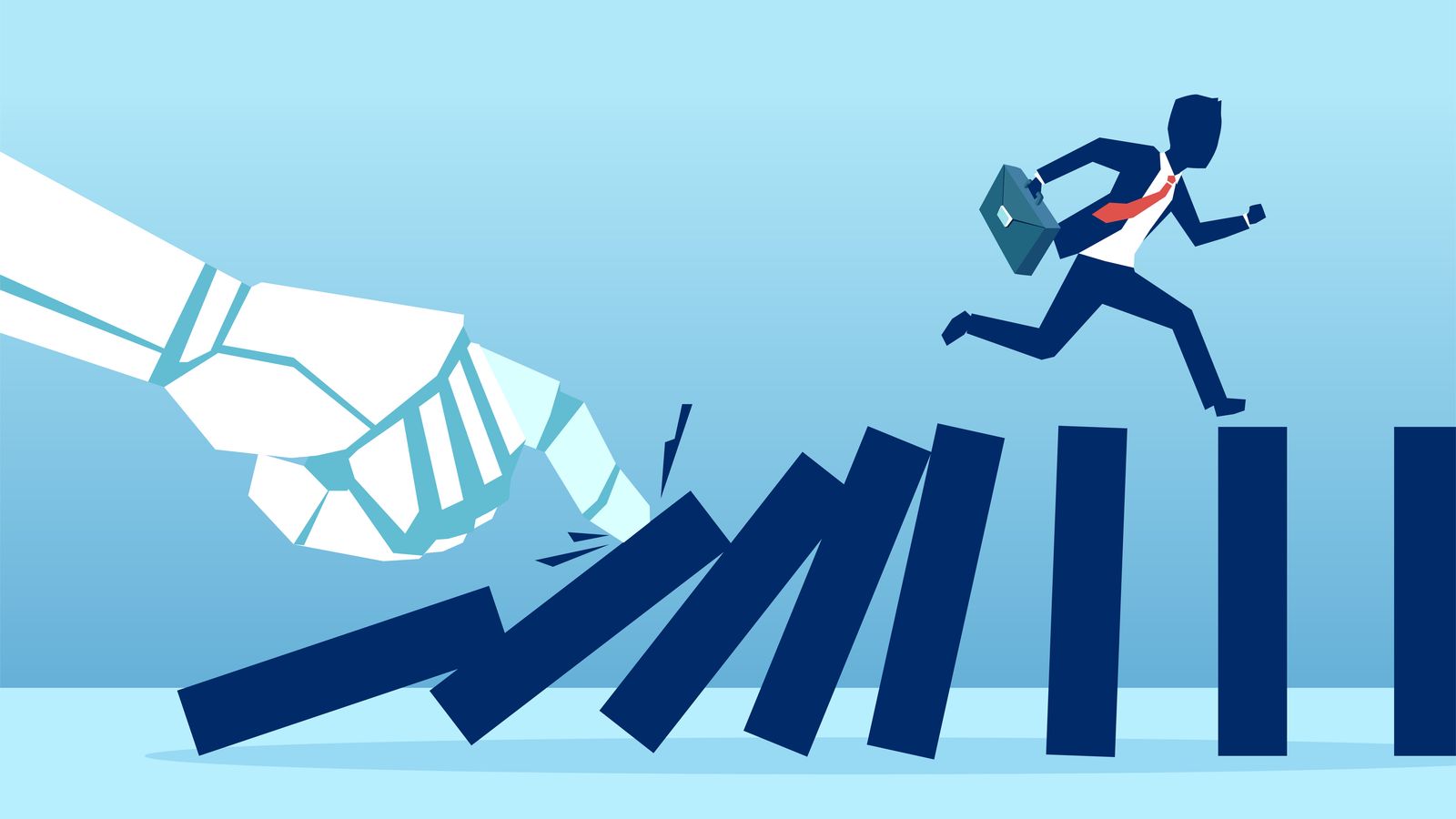
AI Won't Kill Your Job—But This Will: Automation's Real Threat to Workers
The panic is understandable. ChatGPT arrived in late 2022, and within months, think pieces declared the death of writing, coding, design, and customer service. LinkedIn filled with the newly displaced. YouTube offered a hundred videos titled "These 10 Jobs Will Be Gone By 2025." The anxiety wasn't irrational—but it was incomplete.
Three years later, a messier reality has emerged. Some jobs have indeed been hollowed out. Others have simply shifted. And a surprising number have proven almost immune to automation, even as technology advances. The real threat to workers isn't AI itself. It's the jobs that combine just enough routine work with just enough nuance to be partially automatable—but not in ways that save companies money immediately. Those are the roles that get restructured, deskilled, and downsized, often by employers who aren't trying to build the future so much as shave margins.
The Jobs That Actually Disappeared
Start with the empirical foundation. There have been automation-driven layoffs. In 2024 alone, tech companies shed over 260,000 workers—not because they eliminated valuable roles, but because they scaled engineering teams rapidly during the pandemic, then contracted when growth plateaued. That's different from automation replacing workers, but the outcome feels the same.
Looking at broader data: the Bureau of Labor Statistics doesn't yet track "automation-displaced workers" as a distinct category. But jobs in data entry, telemarketing, and basic accounting have declined steadily—not all due to AI, but significantly accelerated by it. A McKinsey analysis in 2023 suggested that by 2030, up to 400 million jobs globally could be affected by automation. But "affected" is the operative word. It doesn't mean eliminated.
The jobs that have mostly vanished sit at the intersection of three properties: they're rule-based, repetitive, and don't require much context-switching. Bank reconciliation. Routine legal document review. Data transcription. Filing insurance claims against standardized templates. These haven't just become cheaper to automate—they've become economically absurd not to automate. A company that keeps a human doing data entry in 2025 is leaving money on the table.
But here's what's remarkable: these aren't the jobs most workers do.
The Bifurcation: Immune vs. Vulnerable
The clearest divide isn't between "jobs AI can do" and "jobs AI can't." It's between jobs where judgment within constraints matters most, and jobs where pure output volume is what you're paying for.
The immune categories:
Jobs requiring real-time physical presence remain largely untouched. Plumbing, electricians, nurses, construction foremen—these occupations involve problem-solving in unpredictable environments. A nurse can't be replaced by AI because the job isn't fundamentally about information processing; it's about presence, observation, and physical intervention. A plumber shows up because your toilet is broken in a unique way. The diagnosis is partly algorithmic, sure, but the execution requires hands and improvisation.
Jobs requiring sustained relationship capital have also proven resilient. Therapists, executive recruiters, sales executives, and teachers face pressure to adopt AI tools—but AI doesn't replace them. A customer doesn't trust a chatbot the way they trust their long-standing accountant. A therapist's efficacy rests partly on continuity and trust. You can't automate that in a way that's better.
Jobs with truly novel, high-variance outputs have remained secure. Product strategists, investigative journalists, marketing creative directors—these are occupations where the expected output is "something we haven't seen before." AI can assist in generating options, but the judgment about what matters is still human.
The vulnerable ones:
The jobs most at risk are those where the work is standardizable but not entirely routine. These are the roles where 70% of the task is mechanical and 30% requires judgment—and that 30% isn't context-rich enough to justify keeping a human for the other 70%.
Middle-skilled business roles are the clearest victims: junior financial analysts, paralegal associates, junior software developers, customer service supervisors, junior copywriters. These are positions where someone does research, pulls together information, makes a judgment call, and writes a report or email. A human does this in 4 hours. GPT-4 does it in 4 minutes. A human gets paid $55k a year for this. GPT-4 costs a company $100 per month.
What's happened isn't replacement—it's restructuring. Companies don't fire the junior analyst. They hire one junior analyst and a mid-career analyst who now does more of the judgment work and less of the grunt work. Or they don't hire the junior role at all. Or they hire one junior analyst, but expect her to do the work three analysts used to do, and she uses AI for the routine parts.
The result: fewer entry-level jobs. That's the real economic shock. Entry-level positions are where people learn, where they discover whether they're competent at a given field, where they build networks. When companies compress the pyramid, younger workers face a steeper ladder.
What Really Threatens a Job: Economics, Not Technology
Here's the underappreciated nuance: technology rarely causes job loss by itself. Economics does. Technology is just the mechanism.
Consider the case of radiologists, repeatedly cited as soon-to-be-unemployed. Hospitals can now use AI to flag early signs of cancer in CT scans, sometimes more accurately than humans. This has been technically possible for five years. Have radiologists been laid off en masse? No. Why? Because radiologists are expensive ($300k+ annually), hospitals face shortages of them, and image analysis is only one part of the job. A radiologist writes reports, discusses cases with clinicians, manages complex patients.
But consider the case of content moderators, who have been consistently displaced. Technology can flag harmful content. A human must review it. But here's the thing: a human reviewing content in Manila costs $200 monthly. A human in California costs $4,000. When AI becomes good enough to handle 80% of the moderation, most companies don't keep humans for the remaining 20%. They pay for the AI and absorb the remaining false positives. The economics are asymmetrical.
So the real question isn't "what can AI do?" It's "what work is economically worth keeping humans for?"
This depends on:
- Wage arbitrage. If a job is done by workers in low-wage countries, AI doesn't need to be very good to be cheaper. If it's done by high-wage workers, AI needs to be exceptional.
- Liability. If errors are costly, companies keep humans (at least for now). Medical diagnosis, financial advising, legal counsel—high stakes = human involvement persists.
- Relationship value. If the customer is paying partly for access to a specific person, that person is safer than if they're interchangeable.
- Compliance burden. Heavily regulated roles (nursing, law) can't simply be handed to AI, even if the technology could theoretically handle it.
The Emerging Threat: The Deskilling Squeeze
The threat most workers should worry about isn't displacement—it's deskilling.
This happens when AI tooling becomes so good that management simplifies a job description to match what the AI can handle. A senior copywriter used to do research, strategy, copy, and revision. Now she does "copy revision"—AI generates options, she picks the best one. She's not laid off, but she's been downgraded. Her salary might stagnate or decrease.
Or consider customer service. Ten years ago, a good support agent needed knowledge, empathy, and judgment. Now AI chatbots handle 80% of cases, and human agents only get the escalations—usually angry customers or complex problems. The job is more stressful and requires less accumulated expertise. The wage ceiling drops.
This is harder to measure than layoffs but often more consequential. A mid-career professional's skills gradually become less valuable because the job itself has been reshaped to reduce the need for those skills. That professional is still employed. They're just earning less in real terms, and their path to advancement has narrowed.
What Workers Should Actually Worry About (and Do About It)
If outright job elimination is overstated, what's the real risk?
First, the risk of your role being compressed into a junior position. If you're in a middle-skill role (junior analyst, junior developer, content writer, researcher), your job description is actively under pressure. The solution isn't to resist AI—it's to evolve your role toward judgment and strategy. Learn what the AI can't easily do and become indispensable for that.
Second, the risk of wage stagnation. Even if your job isn't eliminated, it might become cheaper. This is already happening for copywriters and junior developers. The solution is to develop skills that command premium pricing: deep industry expertise, stakeholder management, strategic thinking.
Third, the risk of being unemployable during transitions. If your field is actively reshaping (accounting, paralegal work, customer service), you're safest if you develop adjacent skills that keep you relevant. This doesn't mean learning to use ChatGPT. It means understanding the business layer above your current role.
Fourth, the raw economic risk that entry-level roles shrink. This is a collective action problem, not an individual one. But individually, if you're early-career, seek out roles that still value human judgment even at junior levels: sales, product, strategy, design. Avoid pure data processing.
The Bottom Line
AI will eliminate some jobs—mostly the ones where humans were already doing low-value-add work. But the more pervasive threat is subtler: the slow compression of the career pyramid, the deskilling of mid-tier roles, and the wage stagnation that follows when a job's complexity is automated away.
The workers who'll thrive are those who stay one level above where automation is happening. Not the person using the AI tool. The person deciding which tools to use and why. Not the person writing the report. The person deciding what the report should say. Not the person answering customer questions. The person defining what customer problems matter most.
That's not a threat to workers who can evolve. But it's very much a threat to those who can't—or who work in sectors where evolution isn't rewarded.